CDR for Electrical Engineer ANZSCO 233311
If you are an electrical engineer planning a move to Australia, the Competency Demonstration Report is the document that decides whether Engineers Australia recognises your degree and your work. It is not a CV and it is not a job application. It is a structured record that shows what you designed, installed, tested or commissioned, and how you thought through each step. Our CDR writing service prepares the full report around your own projects, and the first step is a free evaluation of your background.
This guide walks through a CDR for an electrical engineer under ANZSCO 233311. You will see how to pick career episodes from power distribution, protection and control or building services work, how to write them so your own role stays clear, and how the summary statement ties each episode to the competency elements. If you want the full picture first, read our CDR writing guide for Engineers Australia.
Electrical work ranges from high voltage plant to a single building fit out, and that range is your advantage if you use it well. A substation upgrade, a protection study and a lighting design can each show a different side of your skill. The project risk management plan shows how to name a risk, score it and plan a response before work starts, and that kind of thinking helps when you write an episode too, because every electrical job carries risks you had to manage, and the assessor wants to see how you handled them.
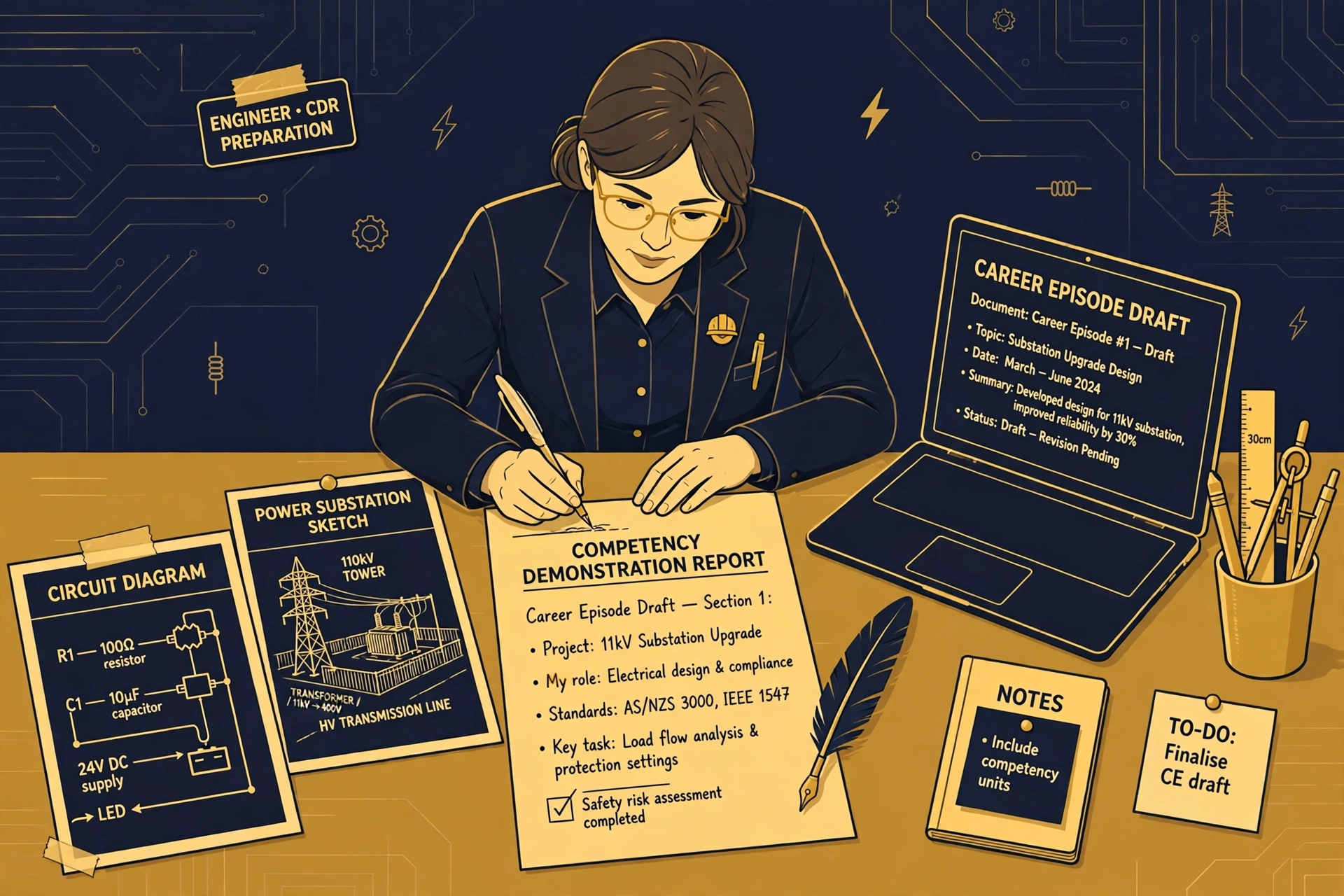
1. What Engineers Australia looks for in an electrical CDR
The assessor reads for personal engineering activity. That means work you did yourself, decisions you made yourself, and problems you solved yourself. A paragraph that says the substation was upgraded tells the assessor nothing about you. A paragraph that says you ran the fault level study, found the breaker rating was too low, and specified the replacement tells the assessor a lot.
The occupation code 233311 covers design, development, testing and supervision of electrical systems such as power generation and distribution, control systems, and building electrical services. Your episodes should sit inside that scope. A project that was mostly buying or mostly supervising labour will not carry much weight, even if the project itself was large. Pick work where you did engineering, and say plainly what that engineering was.
Tone matters too. Write in the first person all the way through. Use plain sentences. Name the software you used, the drawings you produced, the tests you ran, and the result you reached. The assessor is not looking for fine writing. They are looking for proof that you did the work and understood it.
2. Picking your three career episodes
Each career episode covers one project or one clear task inside a project. Three episodes is the standard shape, and the strongest sets show three different kinds of work. A design episode, a protection episode and a commissioning episode together show more range than three design episodes from three similar jobs.
Start by listing every electrical project you worked on in the last few years. For each one, write one line on what you personally did. Cross out any project where your own part is hard to describe. What is left is your shortlist. Pick the three with the clearest evidence: drawings with your name on them, test sheets you signed, a protection study you prepared, or a commissioning log you kept.
| Episode | Project type | What it should show |
|---|---|---|
| Episode 1 | Power distribution design | Your load checks, your cable and switchgear selection, the design choices you defended |
| Episode 2 | Protection and control work | Relay settings, fault studies, testing results you recorded |
| Episode 3 | Building services or commissioning | Lighting and power layouts, site testing, handover checks you signed off |
One episode per project keeps the story clean. If two episodes come from the same site, give each one a different system and a different outcome, or the assessor will read them as one episode written twice.
One more check before you commit. Ask yourself whether you can write at least a page about your own actions on this project without repeating what the team did. If the answer is no, the project is too thin for an episode. A smaller job where you ran the whole design beats a landmark job where you only attended meetings.
3. Writing a career episode that shows your own work
Every episode follows the same shape. Start with the background: what the system was, where it was, when you worked on it, and what your role was. Keep this short. Two or three sentences is enough. The assessor needs context, not a company brochure.
Then comes the main part, and this is where most drafts go wrong. Write what you did, in the order you did it, using I all the way. I sized the cable. I ran the voltage drop check. I found the drop was over the limit on the longest run. I increased the cable size and rechecked the fault level. Each sentence should carry one action that was yours. When you need to mention the team, say what your part was inside the team effort.
Finish with the outcome and what you learned. Did the system pass its tests? Did the client accept the handover? What would you do differently next time? A short honest reflection closes the episode and gives the summary statement something real to point at. If a claim in your episode has no evidence behind it, cut the claim. The assessor reads for proof, and a quiet true sentence beats a loud empty one.
4. The summary statement and how mapping works
The summary statement is a table that links each competency element to the paragraph in your episodes where you showed it. It is not a second essay. It is a map. For each element you write the paragraph numbers that prove it, and you keep the wording short.
Do the mapping after the episodes are written, never before. Read each competency element, then search your episodes for the place where you actually did that thing. If you cannot find it, you have a gap, and the honest fix is to add the evidence to an episode or to pick a different episode. Writing the mapping first and then forcing the episodes to fit it is how drafts end up sounding invented.
How the parts of your CDR fit together
Three episodes carry the evidence. The summary statement points at that evidence. The CPD record shows you keep learning. Nothing in the report stands on its own.
Check the map twice. Every element should point at a real paragraph, and every paragraph you point at should really show that element. An assessor who follows a pointer and finds nothing there will doubt the rest of the map. A map that holds up under that check is what makes a CDR feel solid.
5. Your CPD record
CPD stands for continuing professional development, and the record is a simple list of the learning you have done since your degree. Courses, site training, seminars, workshops, short online courses and structured self study all count. For each item, note what it was, when it happened, who ran it, and how long it took.
Electrical engineers often forget half their CPD because it happened on the job. A new wiring code you studied before a fit out, a vendor training session on a relay range, a safety course the site ran, all of it belongs on the list if you can show it happened. Keep certificates and attendance records where you have them. If a course has no certificate, note the date and the organiser and say so plainly.
The record does not need to be long. It needs to be true and recent. A short list of real learning beats a long list padded with items you cannot back up. If there is a gap in your learning, say what you plan to do about it rather than hiding the gap.
6. Mistakes that weaken an electrical CDR
The first mistake is writing in the team voice. We designed, we installed, we delivered. The assessor cannot tell what you did, so they cannot credit you for it. Read every paragraph and ask who did the action. If the answer is not you, rewrite the sentence.
The second mistake is copying. Borrowed text from a sample CDR or from a colleague is easy to spot because it does not match the rest of your report. It also puts your whole application at risk. Write in your own words, even if your English is simple. Simple and true is what the assessor wants.
The third mistake is vague size. A cable with no rating, a load with no figure, a fault level with no value, these read like stories, not engineering. Put the real figures in. The numbers you actually worked with are the fastest way to show the work was yours. If you need a hand shaping your episodes, our CDR writing service starts with a free evaluation of your background and your projects.
An electrical CDR is not a test of fine writing. It is a test of whether you can show your own engineering work clearly, in your own words, with evidence behind every claim. Pick three projects where your part is clear, write what you did in the first person, map the summary statement to real paragraphs, and keep your CPD record honest. Do that and the assessor can see the engineer in the report. If you would like a hand with the writing itself, our CDR writing service is ready to help, and you can reach out through the contact page for a free quote.
Need a hand with your electrical CDR?
Bright Quill prepares your full CDR around your own electrical projects, starting with a free evaluation of your background.